
The Cyber Helpline’s statistics


Cybercrime, digital fraud & online harm: analytics and insights
Track, analyse, and understand the cybercrime landscape with up-to-date data. Stay ahead with trends and insights to protect yourself and your organisation.
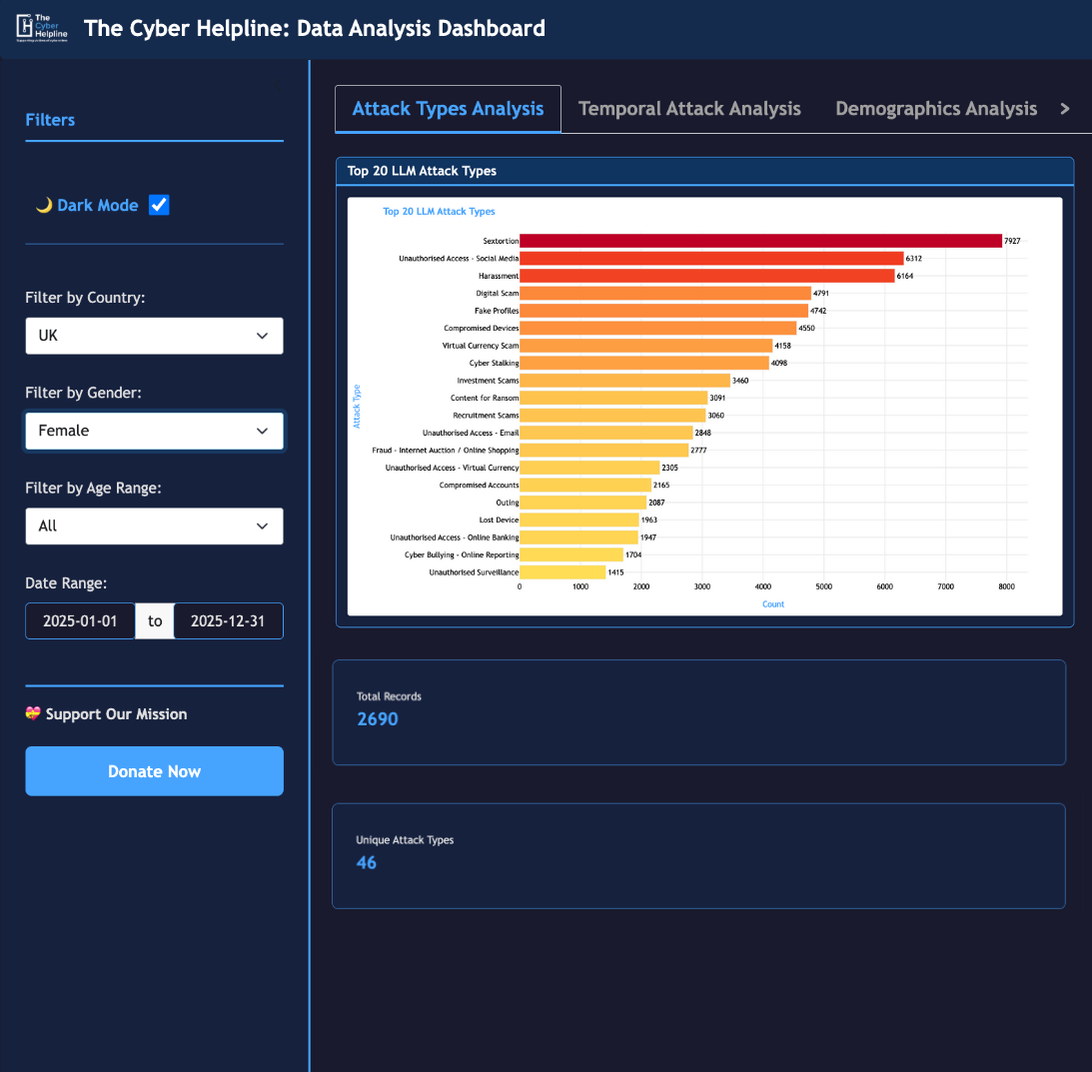
At The Cyber Helpline, we support individuals affected by cybercrime every day. Our cybercrime dashboard provides recent, anonymised data on attacks, demographics, and trends, helping to raise awareness, highlight areas of risk, and enable informed action.
Designed for the public, law enforcement, government agencies, charities, and businesses, the dashboard empowers users to identify patterns, allocate resources effectively, and take steps to prevent cybercrime.
*global trends dashboard drawing from a database of over 40,000 cases, primarily from the UK, USA, and India, spanning 2023 to present (updated monthly)
View current trends
of cyber attacks across the country.
Discover common attack types
including phishing, malware, scams, and social engineering.
Explore demographics
including age and gender, and cybercrime impact by group.
Track evolving attack patterns
seasonal spikes, and emerging cyber threats.
Empower your response to cybercrime
Filter, analyse, take action.
Who can benefit
Individuals
Researchers
Community Organisations
Media
Police & Law Enforcement
Government & Policy Makers
Charities & NGOs
Businesses
In-depth intelligence for verified partners
Some insights, such as specific websites linked to attacks, are only available to verified organisations. Request access to explore the full dashboard, analyse trends in depth, and generate sector-specific reports.
Dashboard FAQs
-
This dashboard shows aggregated insights from anonymised cybercrime victim case descriptions submitted via The Cyber Helpline’s chatbot. It highlights trends such as attack types, demographics, victim–perpetrator relationships, and platforms or services referenced in reported incidents.
-
All data is sourced from case descriptions from The Cyber Helpline’s chatbot data. No external data sources are included.
-
You can explore case data from March 2023 to present day. The data is updated on a monthly basis.
-
Cases were cleaned to remove duplicates, incomplete records, and spam messages. Personally identifiable information was removed before analysis with a dedicated Python library. Classifications were made using a bespoke large language model (LLM) prompt. The model currently used is ChatGPT 4.1
-
Internal testing shows the classification process performs very well overall. However, mistakes are possible, particularly where case descriptions are brief, vague, or ambiguous. The data should be interpreted as indicative rather than definitive.
-
All personally identifiable information is removed using a dedicated Python library before any AI processing takes place. The dashboard only displays aggregated, anonymised data and cannot be used to identify individuals.
-
Data is limited to users who chose to report incidents via the chatbot.
Classifications are model-generated and may contain errors.
Reporting behaviour and chatbot usage can influence trends.
-
Data is only available when there is sufficient volume or data quality to support meaningful analysis. In other cases, data may be restricted due to privacy considerations, limited availability, or because certain features are still under development.
-
Monthly.